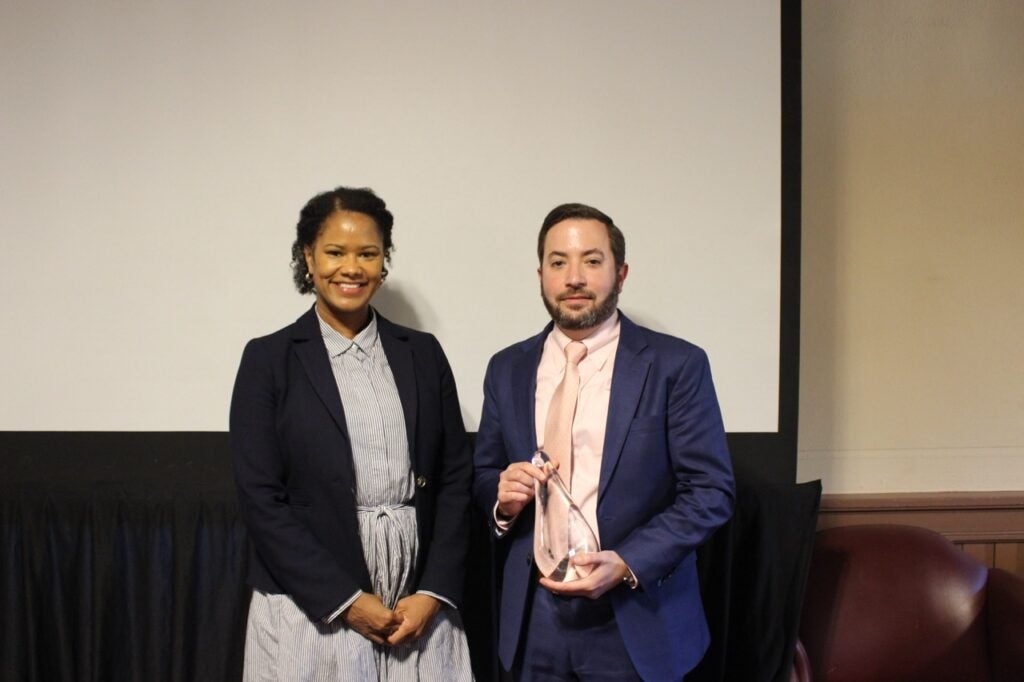
We are pleased to announce the honorees of the 2025 Provost’s Distinguished Achievement in Research Award: Jeremy Fineman and Toshihiro Higuchi.
From left to right: Soyica Colbert and Jeremy Fineman.
The Office of the Provost is pleased to solicit nominations from members of the Main Campus tenure-line faculty for its Faculty Research Awards.
Distinguished Achievement in Research: Recognizes a single distinguished achievement in scholarship and research. The types of achievement envisaged include the winning of a prestigious book prize, the receipt of distinguished awards from one’s peers, or the receipt of a major center grant. It is expected that such achievements will be relatively recent, certainly within the last five years. Junior as well as senior faculty may be nominated for this award. A maximum of one award per year will be made. If circumstances warrant, this award can be received more than once.
Nominations made to the program remain active for three years (or two beyond the year in which the nomination is made) unless the individual is selected for an award in a given year.
Each recipient will receive a $10,000 cash prize, an award, and presentation and recognition at a University-wide Ceremony in the Fall.
Eligibility
Main Campus tenure-line faculty.
Nomination Process
Main Campus faculty should submit their nominations for either award to the Office of the Provost via internalgrants@georgetown.edu.
The nominating officials/departments should provide a letter of nomination, a current version of the candidate’s vita, up to two additional letters from prominent scholars in the field of the candidate, and scholarly materials sufficient to allow evaluation of his/her merits. Nominators and supporting letters should explain the significance of awards or honors that the candidate has received. Occasionally more than one member in a department or unit is eligible and can be nominated. The materials should be submitted to the Internal Grants at internalgrants@georgetown.edu by September 19, 2025. Hard copy materials such as books or journals can be submitted directly to the Vice Provost for Research. Supporting materials from other individuals or institutions may also be submitted to internalgrants@georgetown.edu.
Review Process
Recipient of the award will be selected by the Faculty Research Awards Committee. The Committee has the option of declining to make the award in a given year if, in its judgment, no nomination is sufficiently compelling.
2025: Jeremy Fineman and Toshihiro Higuchi Jeremy Fineman is a Professor in the Department of Computer Science in the College of Arts & Sciences. He holds the Wagner Chair and is the current Director of Graduate Studies. He received his bachelor’s degree from Dartmouth College and his Ph.D. from the Massachusetts Institute of Technology. Before joining Georgetown University in 2011, he held a postdoctoral position at Carnegie Mellon University as a Computing Innovation Fellow. His primary research interests lie in the design and analysis of algorithms, with a focus on parallel algorithms, graph algorithms, memory-efficient algorithms, and scheduling. His award-winning paper on shortest path algorithms of real, weighted graphs entitled, “Single-Source Shortest Paths with Negative Real Weights in O(mn8/9) Time”, won the best-paper award at the 2024 Association on Computing Machinery Symposium of the Theory of Computing. This single paper, only a year after its publication, is already spawning a new thread of work that has been dormant since the 1950s.
Toshihiro Higuchi is an Associate Professor of History in the College of Arts & Sciences and School of Foreign Service. He studies the international history of the nuclear age with a focus on its scientific, technological, and environmental aspects. He also writes about the environmental history of modern Japan in the Pacific world. A native of Japan, he received his Ph.D. from Georgetown University in 2011. Before he returned to Georgetown in 2016, he was a postdoctoral fellow at Stanford University; an American Council of Learned Societies New Faculty Fellow at the University of Wisconsin – Madison; and a Hakubi Project assistant professor at Kyoto University. He is the interim Director of the M.A. in Global, International, and Comparative History Program and the field chair of Regional and Comparative Studies in the School of Foreign Service (SFS). He was a 2024 Wilson Center Fellow and the recipient of the 2024 SFS Faculty Award for Excellence in Teaching. He is an official historian for the International Commission on Radiological Protection and currently serves as the editor-in-chief of the Journal of History of Science, JAPAN and the secretary of the Peace History Society. He is the author of Political Fallout: Nuclear Weapons Testing and the Making of a Global Environmental Crisis (Stanford University Press, 2020). The book won the 2021 Michael H. Hunt Prize for International History from the Society for Historians of American Foreign Relations.
2024: Andrew F. Zeitlin Andrew Zeitlin is an Associate Professor at the McCourt School of Public Policy and a world-renowned Development Economist known for his path-breaking work on the Economics on Education. Professor Zeitlin recently completed a seminal research project illuminating the effects of pay-for-performance contracts on teacher recruitment, effort, and retention in Rwanda. Published in the American Economic Review, the discipline’s premier journal, this work was the product of an ingenious and ambitious experimental design that required a monumental effort to carry out under very challenging conditions. The importance of this work was immediately recognized by the International Development community and directly led to a large grant of $3.1 million from USAID’s Development Innovation Ventures and Agence Française de Développement’s Fund for Innovation in Development, to translate the research into national policy in Rwanda. Thus, this work represents an outstanding achievement as a significant scholarly contribution and for its potential to impact the lives of millions of individuals in concise order.
2023: Gregory Afinogenov Gregory Afinogenov is an Associate Professor in the Department of History. He received his Ph.D. in Russian history from Harvard University and his B.A. in History and Philosophy from Fordham; at Georgetown he teaches courses on Imperial Russian history and beyond. His first book, a prize-winning book, Spies and Scholars: Chinese Secrets and Imperial Russia’s Quest for World Power (Harvard University Press, 2020) looks at the construction of a Russian intelligence network in Qing Dynasty China between 1650 and 1850 and the global ramifications of imperial knowledge-making. More broadly, Afinogenov’s research has included everything from cybernetics in the Soviet Union to pastoral poetry in eighteenth-century New York. In addition to academic publications, his articles and reviews have appeared in venues like n+1, Jacobin, and the London Review of Books.
2022: Diana Kim Diana Kim is an Assistant Professor in the Edmund A. Walsh School of Foreign Service, and a core faculty member of the Asian Studies Program. Her research and teaching courses disciplinary boundaries between political science and history, with area focus on Southeast and East Asia. Professor Kim is a US-Korea NextGen Scholar with the Center for Strategic and International Studies and a New York Review of Books Silvers Grant recipient. Last year she was a Hans Kohn Member at the Institute for Advanced Study in Princeton, and before joining Georgetown, she held a postdoctoral Prize Fellowship at Harvard. She received her Ph.D. in Political Science from the University of Chicago and a B.A. from Korea University.